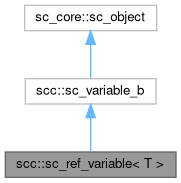
the sc_ref_variable for a particular plain data type. This marks an existing C++ variable as discoverable via the sc_object tree. Whenever possible sc_variable should be used as this does not support value change callback. More...
#include <sc_variable.h>
Public Member Functions | |
| const T & | operator* () |
| get a reference to the wrapped value | |
| sc_ref_variable (const std::string &name, const T &value, bool active_notification=false) | |
| std::string | to_string () const override |
| create a textual representation of the wrapped value | |
| void | trace (sc_core::sc_trace_file *tf) const override |
| register the value with the SystemC trace implementation | |
| void | trace (observer *obs) const override |
| void | notify () const |
| Public Member Functions inherited from scc::sc_variable_b | |
| sc_variable_b (const char *name) | |
| sc_variable_b (sc_variable_b const &)=delete | |
| sc_variable_b (sc_variable_b &&)=delete | |
| sc_variable_b & | operator= (const sc_variable_b &other)=delete |
| sc_variable_b & | operator= (sc_variable_b &&other)=delete |
| const char * | kind () const |
| get the kind of this sc_object | |
Public Attributes | |
| const T & | value |
| the wrapped value | |
Detailed Description
struct scc::sc_ref_variable< T >
the sc_ref_variable for a particular plain data type. This marks an existing C++ variable as discoverable via the sc_object tree. Whenever possible sc_variable should be used as this does not support value change callback.
- Template Parameters
-
T the data type of the wrapped value
Definition at line 441 of file sc_variable.h.
Constructor & Destructor Documentation
◆ sc_ref_variable()
|
inline |
Definition at line 458 of file sc_variable.h.
Member Function Documentation
◆ notify()
|
inline |
Definition at line 492 of file sc_variable.h.
◆ operator*()
|
inline |
◆ to_string()
|
inlineoverridevirtual |
create a textual representation of the wrapped value
- Returns
- the string representing the value
Reimplemented from scc::sc_variable_b.
Definition at line 470 of file sc_variable.h.
◆ trace() [1/2]
|
inlineoverridevirtual |
Implements scc::sc_variable_b.
Definition at line 490 of file sc_variable.h.
◆ trace() [2/2]
|
inlineoverride |
register the value with the SystemC trace implementation
- Parameters
-
tf
Definition at line 481 of file sc_variable.h.
Member Data Documentation
◆ value
| const T& scc::sc_ref_variable< T >::value |
the wrapped value
Definition at line 443 of file sc_variable.h.
The documentation for this struct was generated from the following file:
- /home/eyck/Projects/MINRES/SystemC-Components/src/sysc/scc/sc_variable.h
